


Looking for a new card game that’s quick to learn, a little bit silly, and perfect for family and friends? Meet Trash Pandas, a 20-minute game that hinges on one tempting decision: should you risk it all for just one more roll of the die? It’s a fast, fun game of daring and dumpster diving that will have everyone at the table laughing. Get the Best information about Daftar fiona77.
In the Trash Pandas card game, you’re not just playing cards—you are a mischievous raccoon raiding a trash can for glorious treasures. Your mission is to rummage for goodies like half-eaten pizza and shiny baubles, stashing away the most valuable trash to become the neighbourhood’s top panda. The charming theme turns every card draw into a delightful discovery.
The real heart of the game comes down to a feeling everyone understands: the dare. On your turn, you face a choice. You can stop and safely use the rewards you’ve collected, or you can push your luck by rolling the die again for an even bigger prize. Get too greedy, however, and you could “bust,” losing everything you gathered that turn.
This simple risk-versus-reward choice is what makes Trash Pandas one of the most engaging and quick family card games available. In practice, it’s a perfect recipe for cheers when a risky roll pays off and playful groans when it doesn’t. If you want a game with less time spent on rules and more time spent on fun, it might be the perfect fit for your table.
What’s in the Box? A Quick Tour of Your Trash Panda Toolkit
At the heart of Trash Pandas is a deck of cards, each one representing a piece of glorious, sought-after trash. You’ll find everything from half-eaten pizza and day-old donuts to shiny trinkets and wily schemes. These cards are the treasures you’ll collect, and ultimately, the source of your points at the end of the game.
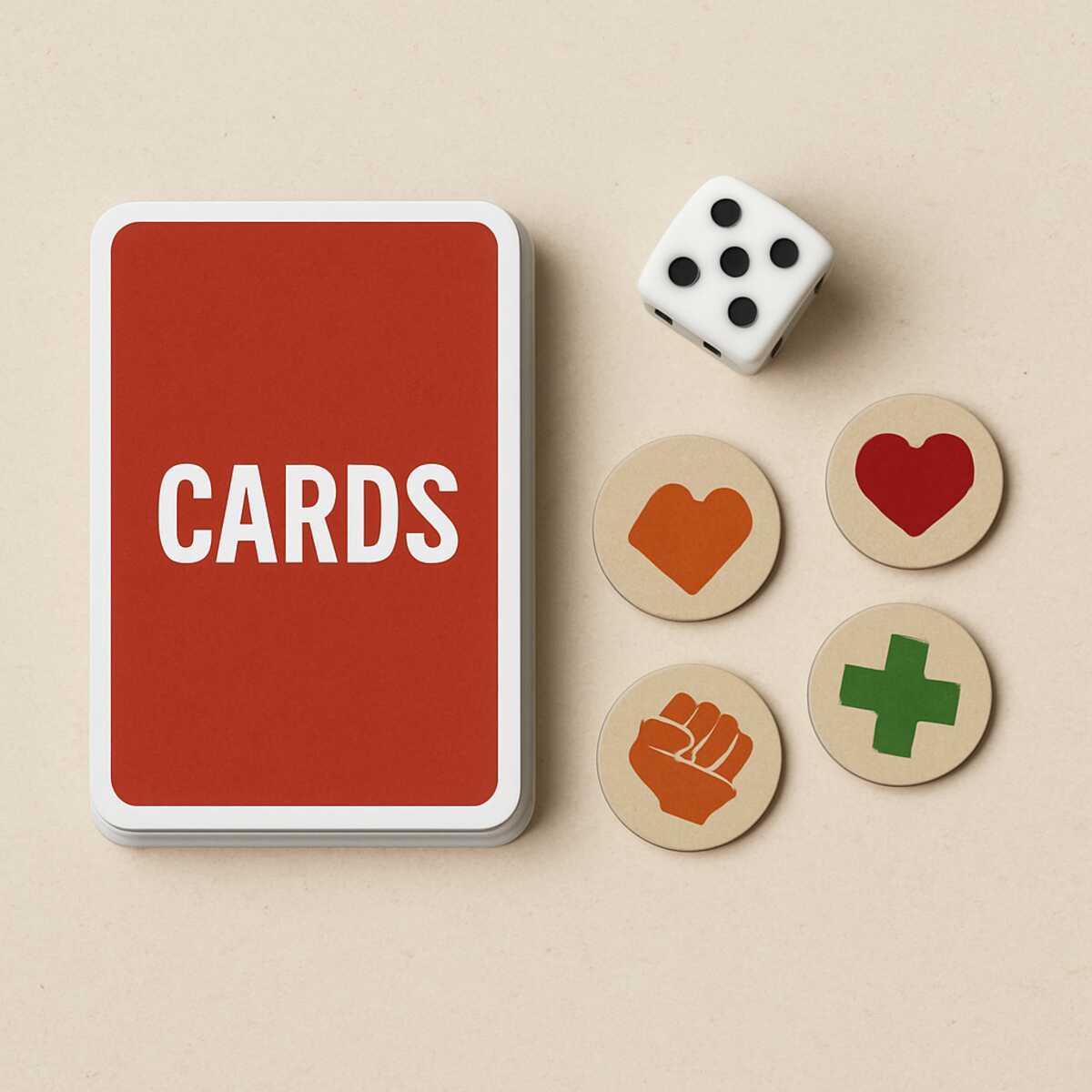
To get your paws on that trash, you’ll use the game’s custom six-sided die and a set of cardboard Action Tokens. Instead of standard pips, the die’s faces show symbols that correspond to the different tokens. Rolling the die is how you earn tokens, and these tokens are what empower you to perform actions like drawing new cards or stashing them away for points.
Think of these three components as your raccoon toolkit. You roll the die to collect your tools (the tokens), then use those tools to manipulate the trash (the cards). It’s a simple but clever system that forms the foundation for all the game’s sneaky and strategic fun.
How Do You Win? The Raccoon’s Ultimate Goal is Stashing the Best Trash
In Trash Pandas, winning is all about proving you’re the cleverest raccoon by collecting the most valuable trash. At the end of the game, you’ll add up the points printed on the cards you’ve managed to secure. The player with the highest total earns the coveted title of “Top Panda” and all the bragging rights that come with it.
The main way to secure those points is through a special action called stashing. Think of stashing as moving a card from your hand into a personal, protected vault. You place it face-down in your own scoring pile, and from that moment on, it’s locked in. Those points are yours, and they’ll be counted for your final score no matter what happens. Stashing is the most direct path to victory.
This is critical because cards in your hand are never truly safe. Another hungry raccoon might use their turn to steal that Day-Old Pizza you were planning to use! Stashed cards, however, are completely protected. No one can ever take them away. This creates a constant, fun tension: do you keep a valuable card in your hand for its ability, or do you stash it now to guarantee its points?
Your First Turn: How to Roll, Risk, and Reap Rewards
Every turn in Trash Pandas is a mini-adventure into the neighborhood trash can, and it all begins with a single action: you roll the die. Forget moving a piece on a board; this roll is your key to unlocking special powers that will help you find and stash the best garbage.
The number you roll determines which special power you get to claim for the turn. Each number on the die corresponds to a unique action token, like ‘Draw,’ ‘Steal,’ or ‘Stash.’ If you roll a 3, for example, you take the ‘Stash’ token and place it in front of you. This token is now yours to use, representing your first successful find on this dumpster dive.
With one token successfully claimed, you face the game’s most tempting question: do you stop? You can end your rolling phase at any point and use the powers of the tokens you’ve collected. Or… you can push your luck and roll the die again, hoping to collect another token for an even more powerful turn.
Herein lies the delicious risk. While rolling again can lead to bigger rewards, it can also lead to disaster. If you ever roll a number that you’ve already rolled this turn, you “bust!” For example, say you rolled a 2 and a 5. Feeling bold, you roll again. If you get a 1, 3, 4, or 6—you succeed! But if you roll another 2 or 5, you bust. When that happens, you lose all the tokens you just collected, and your turn ends immediately in disappointment. This constant, tense decision is what makes every turn a fun gamble.
What Do The Action Tokens Do? A Guide to Drawing, Stashing, and Stealing
Those tokens you risked everything to collect are the fuel for your turn. After you decide to stop rolling (and before you bust!), you get to spend them to perform actions. Think of them as your raccoon’s special moves for rummaging through the trash. While you’ll discover several abilities, learning the two most common actions—Draw and Steal—is the first step toward becoming the top panda.
Each token gives you a simple but important power. One helps you build up your resources, while the other lets you get a little mischievous with your fellow raccoons.
- Draw: This is your primary way of getting new cards. For each “Draw” token you spend, you take the top card from the deck and add it to your hand. More cards mean more options.
- Steal: Ready to embrace your inner bandit? Spending a “Steal” token allows you to take one random card from an opponent’s hand and add it to your own. It’s a great way to disrupt their plans and maybe even snag a valuable card they were hoping to use.
These two actions form a simple but strategic choice: do you focus on building your own hand, or do you take a chance and swipe from a rival?
What Does the Blammo! Token Do? Unleashing Chaos on Opponents
Among the trash, you’ll sometimes find a Blammo! token. So, what does the Blammo! token do? Unlike other tokens that give you a direct benefit, this one creates chaos for your rivals. When you use it, you put another player in a tough spot by forcing them to choose the lesser of two evils. It’s the perfect tool for a mischievous raccoon looking to shake things up.
After you pick a target, they face a difficult choice. They must either discard half the cards from their hand (rounding up), or they can let you re-roll one die from your turn. This second option is a game-changer if you’ve ‘busted’ by rolling a duplicate number, as it gives you a chance to undo your mistake and save your turn from ruin.
This choice is a key part of the trash pandas game rules and a source of great strategy. You can use Blammo! offensively against a player with a huge hand, forcing them into a painful discard. Or, you can use it defensively as a safety net. If you push your luck too far and bust, spending a Blammo! token might convince an opponent to grant you a re-roll instead of losing their own cards. It’s a powerful move that turns failure into a dramatic second chance.
How to Count Your Loot: A Simple Guide to Final Scoring
All your frantic dumpster diving eventually comes to an end. The game’s finale is triggered once the last card is drawn from the main deck. When this happens, every player, including the one who drew the final card, gets one last turn. This gives everyone a final chance to stash cards and shift the balance before it’s time to see who is the ultimate Trash Panda.
Once the final turns are over, it’s time to count your loot. This is where trash pandas scoring explained becomes simple: it’s all about having the most. For each type of card in the game—like Day-Old Pizza or Shiny Things—you’ll check which player has collected the majority of that card type in their personal stash. You don’t score for having a little of everything; you score by cornering the market on specific treasures.
To see who gets points, you compare stashes. For instance, say you stashed three Day-Old Pizza cards. If no one else has three or more, you win the points for pizza! The point value is printed right on the card (in this case, 4 points). You’d add those 4 points to your total and then check who has the most of the next card type, continuing for all the different kinds of cards.
But here’s a crucial rule: ties are worthless. If you and another player both have three pizza cards, neither of you scores those points. This all-or-nothing element is a key part of the trash pandas game rules and makes stealing at the last minute so powerful. After totaling the points from all your majorities, the player with the highest score wins!
Playing with Two? How the Trash Pandas Two-Player Rules Work
Playing with just one other person adds a clever twist to keep the game competitive. The official trash pandas two player rules introduce a third, phantom player. Whenever a card directs you to give a card to another player (like through stealing or giving away unwanted cards), you instead add it to a neutral “dummy” stash. This pile doesn’t take turns, but it silently collects trash throughout the game, acting as a spoiler.
When it comes to scoring, this dummy stash is treated like a real player. For example, if it accumulates three ‘Nasty Nibbles’ cards and you only have two, that phantom player wins the majority. This means no one gets those points! It cleverly prevents two players from just splitting all the majorities between themselves, keeping the scoring race tight and unpredictable, a detail often praised in a trash pandas review.
This single change makes the two-player game surprisingly strategic. You now have to consider whether stashing a card is worth it, or if it’s better to hold onto it to prevent the dummy pile from winning a majority later.
Is Trash Pandas Good for Families and Kids?
Absolutely. In fact, is trash pandas good for families isn’t even a question—it’s a go-to choice if you’re looking for quick family card games. A full game wraps up in about 20 minutes, and you can teach the rules in five. This means less time explaining and more time playing, getting everyone from kids to grandparents into the action almost instantly, a hallmark of the best Gamewright card games.
The game is officially recommended for ages 8 and up, which feels just right. While younger kids might need help reading the cards, an 8-year-old can easily grasp the main goal: roll the die, take a token, and try to stash the most valuable trash. The thrill of pushing their luck is universally exciting and requires no complex strategy, just a bit of daring that always gets a reaction.
But what makes it truly special is how it keeps everyone engaged. The simple risk-reward choice is tense enough for adults, and the ability to steal cards from Mom or Dad always gets a laugh. It bridges the generation gap beautifully.
Three Simple Tips to Become a More Cunning Raccoon
While a lucky roll is always exciting, you don’t have to leave the entire game to chance. Learning how to play Trash Pandas smartly is about managing your greed and keeping an eye on your rivals. These simple tips will give you a strategic edge without bogging you down in complex math.
The biggest question in the game is when to stop rolling. A great rule of thumb, and often the best trash pandas strategy, is to consider stopping after three or four successful rolls. With each new number you roll, the odds of busting on your next attempt get significantly higher. It’s often better to safely use the three tokens you have than to risk it all for a fourth and end up with nothing.
Next, pay close attention to what your opponents are stashing. Remember, you score bonus points for having the most cards of a certain type. If you see another player already has a big pile of “Day-Old Pizza,” trying to compete for that majority is an uphill battle. A smarter move is to pivot and start stashing “Shiny” objects or another trash type that no one else seems to be collecting.
Finally, never underestimate the power of being unique. If you stash just one “Moldy Cheese” card and no one else has any, you automatically win the majority for that category. Stashing a single, uncontested card early is a sneaky way to lock in points.
Trash Pandas vs. Exploding Kittens: Which Quick Card Game is Right for You?
That mix of luck and lighthearted rivalry is a key ingredient in many quick family card games, often drawing comparisons between Trash Pandas and another fan favorite, Exploding Kittens. While both are fast, silly, and perfect for parties, they deliver very different experiences. The key difference is your goal: Trash Pandas is a race to build up the most points, while Exploding Kittens is a tense game of survival where you just want to be the last player left.
The main drama in Trash Pandas comes from an internal debate: “Should I push my luck for one more roll?” While you can steal from others, the game’s core feeling is about managing your own greed. Exploding Kittens, on the other hand, is built on more direct conflict. It’s a classic “take-that” game, where you actively play cards on your opponents to force them into danger, hoping they draw the dreaded exploding card instead of you. The tension comes from trying to sabotage everyone else before they can sabotage you.
So, which is right for your group? Here’s a quick look at how they stack up:
| | Trash Pandas | Exploding Kittens | | :— | :— | :— | | Main Goal | Collect the most points | Be the last player standing | | Core Feeling| Greedy risk-taking | Anxious, rising tension | | Best For | A light-hearted race | Playful sabotage & suspense |
Ultimately, your choice depends on whether you prefer a game about getting rich or a game about not getting blown up.
Loved Trash Pandas? 3 Other Games You Might Enjoy
If the quick, chaotic fun of Trash Pandas has you looking for your next favorite game night addition, you’re in luck. The world of board games is filled with titles that capture a similar spirit of fast-paced fun and lighthearted risk. Based on what you enjoy about digging through the deck as a raccoon, here are a few other games similar to Trash Pandas that are worth a look.
For those who love the simple rules and fast card play, Sushi Go! is a perfect next step. In this charming game, you pick a single sushi card from your hand and then pass the rest of your cards to the player next to you. Everyone reveals their choice at the same time, trying to collect sets of adorable maki rolls, tempura, and sashimi. It’s wonderfully quick, easy to teach, and captures that same feeling of trying to grab the best items before someone else does.
If rolling the die was your favorite part of being a raccoon, then you’ll love the dice-chucking mayhem of King of Tokyo. In this game, you are a giant monster trying to destroy Tokyo and battle other monsters. You roll a handful of chunky dice to gain points, heal yourself, or attack your rivals. It dials up the excitement and player interaction, making every roll a big, cinematic moment for the whole table.
Finally, if the heart-pounding “push-your-luck” decision was what truly hooked you, then The Quacks of Quedlinburg is a must-try. This game is built entirely around that thrilling risk/reward feeling. You play as a quack doctor pulling ingredient chips from a bag to brew a potion, and the more you pull, the more valuable your potion becomes. But be careful—pull too many of the wrong ingredients, and your whole pot explodes! It takes the central tension of Trash Pandas and makes it the star of the show.
Should You Get Trash Pandas? A Final Verdict for Your Game Night
You now understand the delicious tension baked into every turn of Trash Pandas—that pivotal moment of deciding whether to play it safe or risk it all for one more roll of the die. Based on this Trash Pandas board game review, our recommendation is clear. If you’re wondering is Trash Pandas good for families or are looking for quick family card games, this is an easy choice. It’s the perfect ice-breaker for parties or a go-to for a fast game night, delivering guaranteed laughs without a complicated setup.
Ultimately, this isn’t just a game about cards; it’s about the shared groans when a player busts and the cheers when a risky move pays off. Your first game is your chance to create one of those moments. Go on and embrace your inner raccoon—it’s time to see what treasures you can stash away.
