


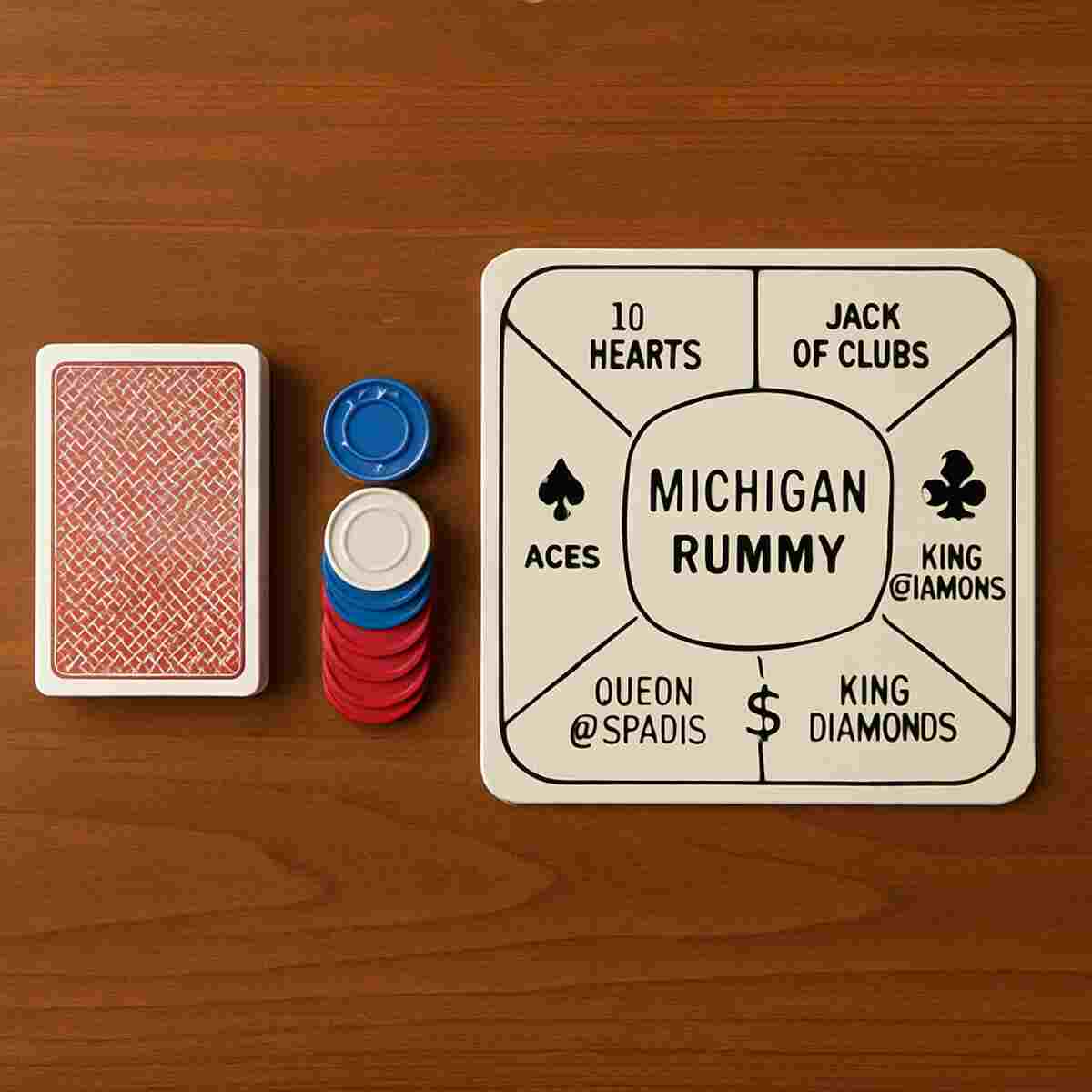
Looking for a new card game that’s easy to learn but exciting every time you play? Meet the Michigan Rummy card game. It’s the perfect blend of simple rules and surprising moments, making it a fast favorite for family gatherings and one of the most beloved family card games for a reason. To learn more, check out cadetv.com
At its heart, Michigan Rummy is actually two games in one. You’re playing a classic card-shedding game where your main goal is to be the first person to empty your hands. But at the same time, you’re playing on a special layout, turning it into one of the most unique rummy style board games you’ll ever encounter.
This unique blend creates two distinct ways to win. You can steadily play your cards in sequence, hoping to go out first and collect a penalty from the other players. Or, you can suddenly play a specific “Pay Card” that matches a space on the board, allowing you to scoop up a tempting pile of chips in an instant. It’s a game of careful planning punctuated by sudden bursts of luck.
The best part is how quickly everyone can join the fun. You don’t need to know complicated strategies or memorize long lists of rules to get started. If you know your card suits and can count, you’re ready. Let’s get you set up to play.
What You Need to Play: Gathering Your Game Night Tools
Before dealing the first hand, you’ll need to gather a few simple tools for the game. There are only three essential components required to get started, and you might already have them at home.
- What You’ll Need:
- A standard 52-card deck (no jokers).
- A Michigan Rummy / Tripoley game board or tray.
- Poker chips or other tokens (about 50 per player).
When it comes to chips, a great rule of thumb is to give each player around 50 to start with. This provides everyone with enough to contribute to the board at the beginning of each hand while still keeping a healthy personal stash. If you don’t have poker chips, don’t worry! Pennies, buttons, or even wrapped candies work just as well for betting.
The game board itself might look complex, but its job is straightforward. It’s simply a mat to hold chip pools on special sections called “Pay Cards.” These are predetermined cards, like the Ace of Hearts or the Jack of Diamonds, that earn you a pile of chips if you are the one to play them. With your gear gathered, you’re ready for the first real step: setting up the game.
The Setup: How to Deal the Cards and ‘Ante Up’
With your chips in front of you, the first action of every hand is to “ante up.” This simply means everyone helps create the prizes for the round. Before any cards are dealt, each player must take one chip from their personal stack and place it onto every single pay space of the game board. You’ll quickly see these small piles grow into tempting jackpots that everyone will be eager to win.
Now it’s the dealer’s turn to get the cards in play. In Michigan Rummy, the dealer shuffles and deals out the entire 52-card deck, regardless of how many people are playing. The cards are distributed one at a time, clockwise, to each player. Crucially, the dealer will also deal one extra hand to an empty spot on the table, as if to an invisible player.
This extra set of cards is called the “dummy hand,” and its cards are out of play for the entire round—nobody gets to see or use them. Because the full deck is dealt out this way, some players will end up with one more card than others. This is a normal and expected part of the game! In fact, the cards locked away in the dummy hand are what create unpredictable “stops” later on.
The board is now primed with chips and everyone is holding their secret hand of cards. Your first objective is simple: be the first player to get rid of all the cards you were dealt. The main way you’ll do that is by playing cards in sequences, which is the heart of the game’s first phase.
Phase 1: Playing Sequences to Empty Your Hand
The player to the dealer’s left kicks things off. To play, you build what’s called a sequence—a run of cards from the same suit, played in order from low to high (Aces are low). The first player can start with any card from their hand, like the 4 of Diamonds. They place it face-up on the table, announcing “Four of Diamonds,” and their turn begins. This simple action is the foundation of how to play Michigan Rummy.
Your turn continues for as long as you have the next card in that suit. After playing the 4 of Diamonds, you would look in your hand for the 5 of Diamonds. If you have it, you play it right away. Then you check for the 6. If you have that, you play it, too! You keep playing one card after another, building the sequence and quickly emptying your hand. For a moment, everyone else just watches as you lay down card after card.
Eventually, you’ll reach a card you don’t have. Let’s say you just played the 6 of Diamonds, but you don’t have the 7 of Diamonds. This is called a Stop. Your turn immediately ends because you cannot continue the sequence. Why don’t you have it? Another player is holding it, or it’s one of the cards hidden away in that dummy hand, making it impossible to play for this entire round. This unpredictability is what makes these rummy-style board games so exciting.
The next player doesn’t get to start their own sequence. Instead, everyone’s attention turns to finding the one card that can restart the chain—in this case, the 7 of Diamonds. The hunt for that “stop card” completely changes the flow of the game.

The ‘Stop’: What to Do When You Can’t Play the Next Card
When a sequence stops, the hunt is on. Following our example where the 6 of Diamonds was the last card played, the dealer will ask, “Who has the 7 of Diamonds?” Play doesn’t just go to the next person in line. Instead, whoever holds that specific card gets to play it, starting a sequence from their own hand. This is a core rule of the michigan rummy card game, causing the action to jump around the table and keeping everyone on their toes. The turn is now theirs, and they will continue playing cards in that suit until they, too, are stopped.
But what if nobody speaks up for the 7 of Diamonds? This means the card is in the “dummy hand” and is out of play for this round. In this case, the player who was just stopped—the one who played the 6 of Diamonds—gets a huge advantage. They now get to start a brand new sequence from their hand using a card from any suit other than Diamonds. Gaining control like this is part of the best strategy for rummy board games as it lets you steer the game toward suits where you are strong.
This mechanic reveals why holding high cards can be so powerful. If you play a King, you automatically “stop” the run because there is no higher card in the suit. This guarantees that you get to start the next sequence, giving you control of the board. While controlling the flow of cards is important, there’s an even more direct path to victory: playing the special cards that are directly tied to winning the kitty pot. These are known as Pay Cards, and they’re what make the game truly exciting.
Phase 2: The Payout! How ‘Pay Cards’ Win You Chips
While getting rid of your cards is one goal, the real excitement in Michigan Rummy comes from winning chips directly from the board. This happens when you play a “Pay Card.” A Pay Card is simply a card in your hand that matches one of the specially marked spaces on the game board.
For instance, imagine the “Queen of Clubs” space has a nice pile of chips on it. The moment you play the Queen of Clubs from your hand as part of a sequence, you immediately stop and scoop up all those chips. It’s that simple! You get paid the instant your card hits the table. So, what are the pay cards you should be looking for on a typical tripoley game board layout? Most boards include:
- An Ace of a specific suit (like Hearts)
- A King of a specific suit (like Spades)
- A Queen of a specific suit (like Clubs)
- A Jack of a specific suit (like Diamonds)
- The 7-8-9 Sequence
- The “Kitty” Pot
The “7-8-9” and “Kitty” spaces have unique rules. To win the “7-8-9” pot, you must play the 7, 8, and 9 of the same suit consecutively in a single turn. As for winning the kitty pot, that’s often a prize for being dealt a special combination before play even begins. A common house rule gives it to the player holding a specific high pair, like the ace on king-queen of hearts if that’s the designated pay suit.
Balancing your desire to empty your hand against the opportunity to play these valuable Pay Cards is the central challenge of the game. It creates a fantastic tension between playing it safe and going for the big score. But there’s still one more major pot on the board—one you can sometimes win before a single sequence is even played.
The Poker Round: How to Win the Big Pot Before a Card is Played
Just when you think you’re ready to start playing sequences, some versions of the game, especially Tripoley, throw in a fun, fast-paced twist. This is a key difference when comparing tripoley vs rummy 500: a quick Poker round. Before anyone lays down a card for the main Rummy phase, players get a chance to win the chips piled on the “Poker” or “Best Hand” space. It’s a tense mini-game that happens right after the deal, using the exact same cards you were just dealt for the main event.
The process itself is surprisingly fast and provides a great opportunity for a little bluffing. Everyone secretly looks at their hand and decides if they have a strong set of cards. Starting with the player to the dealer’s left, each person announces if they want to “play” for the Poker pot or “fold” (drop out). If your hand looks weak, folding is a safe bet. Players who believe they have a chance to win stay in. Once everyone has decided, all the players who stayed in reveal their hands to see who wins.
You don’t need to be a poker whiz to handle this part. The winner is simply the player with the best five-card hand among those who stayed in. You don’t need to memorize all the rankings, but the basics are easy: a pair is good, two pairs are better, and three-of-a-kind beats them both. If there’s any doubt, a quick search for “poker hand rankings” will settle it. This distinct phase, similar in spirit to how pinochle rummy scoring uses different ways to earn points, adds another layer of excitement. Once a winner collects the Poker pot, the Rummy phase of the game finally begins.
How a Round Ends: The Big Payday for Going Out First
The ultimate goal in the Rummy phase of each round is simple: be the first player to get rid of all your cards. The moment you play your final card onto a sequence, you shout “Out!” and the round immediately stops. You’ve successfully emptied your hand while everyone else is still holding theirs. This victory comes with a sweet reward, not from the board, but directly from your opponents’ pockets.
As the winner of the hand, you get to collect a payment from every other player. The rule is straightforward: for every card they are still holding, they must pay you one chip. This direct payout system, where scores are settled immediately, is a feature that makes games like this and even aspects of pinochle rummy scoring so engaging. If a player can’t pay because they’ve run out of chips, they are typically out of the game, though many families play with more forgiving house rules.
But what about any chips left on the board? Often, not all the Pay Cards are played in a single round. Any chips on those unclaimed spaces, including the central “Kitty” or “Rummy” pot, simply stay there. This is where the excitement builds from round to round. An unclaimed pot for the Ace of Spades might grow over several hands, making the eventual prize for winning the kitty pot a game-changing moment. With the winner paid and the board set, the deal passes to the left for the next exciting round.
Your First Winning Strategy: 3 Simple Tips for Beginners
Knowing the rules is the first step; winning takes a bit of strategy. Michigan Rummy isn’t just a game of luck; it’s about balancing two key goals: emptying your hand and snatching valuable chips from the board. The best strategy for rummy board games like this one often comes down to a few smart decisions. Here are three simple tips to give you an edge.
First, get rid of your “orphan” cards early. An orphan is a low-ranking card, like a 3 or 4, that doesn’t connect to anything else in your hand. Since you can’t use it to build a sequence of your own, it’s just dead weight. When you have the chance to start a new suit on the table, lead with one of these lonely cards to clear it from your hand and improve your chances of playing out your other, more connected cards later.
Next, you have to decide between continuing a run and cashing in. While playing a long sequence is satisfying, always prioritize playing a valuable Pay Card. For example, imagine the Jack of Diamonds space on the board has ten chips piled on it. If you have the chance to play that Jack, do it! Don’t hold onto it hoping to play a 9-10-Jack sequence later. Securing a big prize by winning the kitty pot is often a game-changing move that puts immediate pressure on your opponents.
Finally, understand that stopping another player is a powerful move. If an opponent is playing a long run of spades and you hold the next card in the sequence, playing it not only stops their momentum but also gives you control of the game. This focus on both card-shedding and pot-grabbing is a core concept that applies across many similar card games, even those with different royal rummy rules. Mastering these simple tactics is the first step toward becoming the player to beat.
Common Questions and Fun Variations
As you get comfortable with the game, a few practical questions naturally arise. For instance, can you play without a board? Absolutely! All you need is a piece of paper and a pen. Simply write down the names of your chosen Pay Cards (like Ace of Hearts, Queen of Spades, etc.) and use those designated spots on the paper to hold the chips. It’s a perfect solution for a spontaneous game night, ensuring the fun isn’t limited by what’s in the box.
Another common scenario is figuring out what happens when a player runs out of chips. While they could be out of the game, a more inclusive house rule is to allow another player to “stake” them. The staking player gives the person some chips to continue playing, and in return, they get a cut (often 50%) of any pots the staked player wins. This keeps everyone at the table and adds a fun layer of temporary alliances.
You might also wonder how this differs from other card games, prompting a mental tripoley vs rummy 500 comparison. The key difference is the style of play. Michigan Rummy is a “Stops” game, where everyone plays on a single, shared sequence until someone is “stopped” because they don’t have the next card. Games like Rummy 500 are “melding” games, where players focus on forming sets and runs within their own hands. This “Stops” mechanic is what makes it one of the best rummy style board games for interactive, fast-paced play.
The game’s real charm lies in its flexibility and the lively moments it creates between friends and family. Don’t be afraid to make the rules your own to fit your group.
You’re Ready to Play: A Quick-Reference Rules Summary
You’re ready to host your first game of Michigan Rummy! This classic is easy to introduce to friends and family, creating moments of sudden luck and friendly competition. For your first few rounds, keep this quick guide handy.
Michigan Rummy in a Nutshell:
- 1. Setup: Ante 1 chip to each board space. Deal all 52 cards.
- 2. Play: Start a sequence with a low card. Continue as long as you have the next card.
- 3. Stops: If you can’t play, the turn passes to whoever has the needed card.
- 4. Pay Cards: If you play a card matching a board space, take the chips.
- 5. Win the Round: First player to run out of cards collects 1 chip per card left in opponents’ hands. Unclaimed board chips remain.
The rules are a vehicle for excitement—the sudden thrill of playing a Pay Card or the collective groan when a sequence stops just short of the goal. You now have everything you need to introduce this classic to your friends and family. Shuffle up, deal the cards, and let the fun begin.
